
How Can AI Improve Language Teaching?
How Can AI Improve Language Teaching? Lessons from the AI in Action Conference
If you’ve been wondering how to use AI in language teaching without losing sight of good pedagogy, you’re certainly not alone.
Across our profession, teachers, academic managers and teacher educators are asking the same questions. Which AI tools genuinely support learning? How do we use them ethically? How do we help teachers build confidence without simply chasing the latest technology?
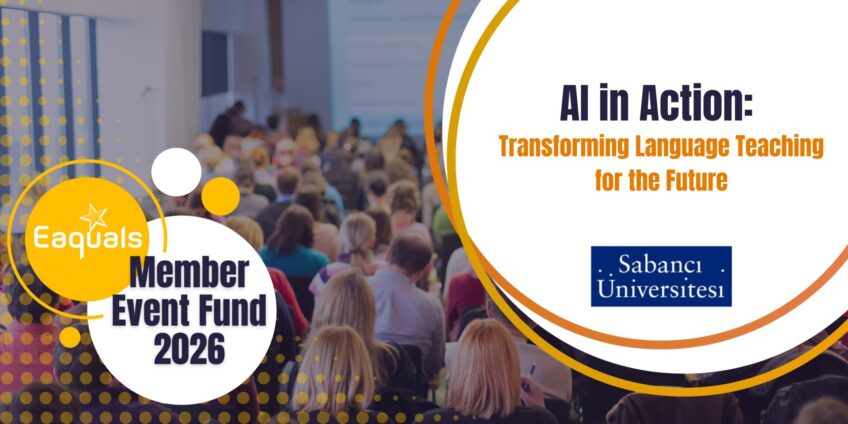
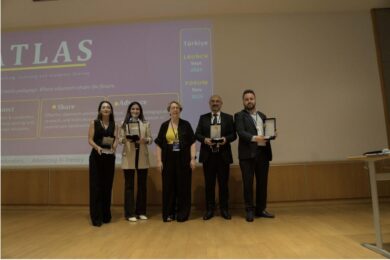
These were exactly the conversations that brought together 65 language education professionals from more than 25 institutions across Türkiye for AI in Action: Transforming Language Teaching for the Future, hosted by Sabancı University‘s School of Languages.
Importantly, the event was made possible through the Eaquals Member Event Fund 2026, whose support enabled a high-quality professional development event that brought together practitioners, researchers, educational leaders and policy makers to learn from one another.
But what made the day stand out wasn’t the technology.
It was the people.
Moving beyond AI hype
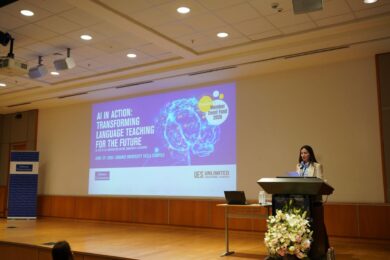 There’s no shortage of conferences talking about artificial intelligence. What made AI in Action different was its focus on what educators are actually doing in classrooms today.
Throughout the day, participants explored AI from several perspectives:
- national education policy
- ethical and responsible implementation
- classroom practice
- teacher professional development
- institutional leadership
Rather than presenting AI as a quick solution, every session returned to the same principle: pedagogy comes first.
That message resonated strongly with attendees looking for realistic ways to integrate AI into language teaching without compromising learner autonomy, critical thinking or academic integrity.
Learning from real classroom practice
One of the highlights of the conference was the interactive session AI in Our Classrooms, facilitated by Jacqueline Einer.
Instead of simply demonstrating AI tools, participants were introduced to authentic examples of how Sabancı
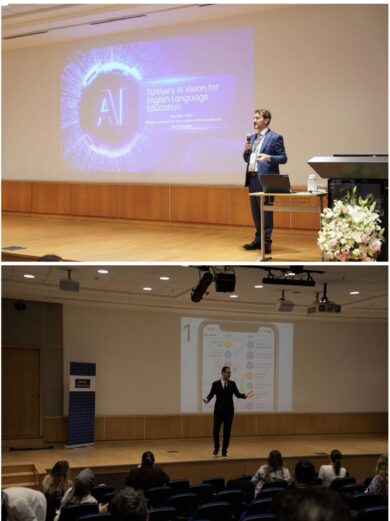
University teachers and students are already using AI to support language learning and professional development.
The discussion quickly expanded beyond presentations.
Around the tables, colleagues exchanged ideas, shared challenges and compared how AI is being introduced in very different institutional contexts. A live survey captured participants’ views on institutional AI implementation, creating an immediate snapshot of where the sector currently stands.
For many attendees, these peer conversations became one of the most valuable parts of the day.
They left not only with new ideas, but with new professional connections and practical approaches they could adapt within their own institutions.
From policy to practice
The programme deliberately connected the bigger picture with day-to-day teaching.
The opening plenary by Mustafa Canlı from Türkiye’s Ministry of National Education explored how national policy is shaping AI integration across education. Later, Professor Yavuz Samur brought those ideas into the classroom, demonstrating practical applications while addressing essential ethical questions around privacy, bias and responsible AI use.
Together, these sessions helped participants understand not only what is changing, but also how educators can respond confidently and responsibly.
A professional development model others can use
The closing keynote generated particular interest.
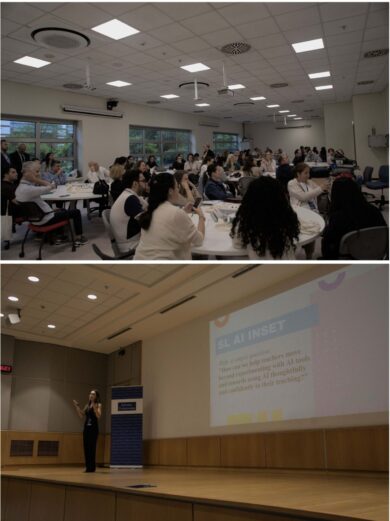
Özlem Zengin and Züleyha Tülay shared the design and outcomes of the Sabancı University School of Languages AI INSET Programme, a five-session professional development model that supported instructors in developing genuine AI fluency.
Rather than focusing on individual tools, the programme encouraged teachers to:
- critically evaluate AI
- experiment safely
- reflect on classroom practice
- develop pedagogically meaningful activities
- make informed decisions about AI integration
The response from participants was overwhelmingly positive because the model felt transferable.
Many recognised that successful AI implementation depends less on technology itself and more on sustained, well-designed professional development.
Building a community of practice
Perhaps the most significant outcome of the event wasn’t confined to the conference programme at all.
The discussions highlighted a clear appetite for continued collaboration between universities, schools and educational organisations working in English language teaching.
Participants expressed strong interest in building networks where educators can continue sharing experiences, classroom practice and institutional approaches to AI.
This momentum will continue with a national meeting planned for November, led by Sabancı University’s School of Languages, bringing together leaders from high schools, university preparatory programmes and higher education to explore how institutional policies can better reflect the realities of teachers’ and students’ everyday use of AI.
Why the Eaquals Member Event Fund mattered
Professional conversations like these don’t happen by accident.
The support provided through the Eaquals Member Event Fund 2026 made it possible to create a practitioner-focused event that welcomed educators from a wide range of institutions and professional backgrounds.
By supporting member-led initiatives, the fund helps create opportunities for educators to learn from one another, exchange ideas and develop solutions that benefit the wider language education community.
The AI in Action conference demonstrated exactly what that support can achieve: meaningful dialogue, practical learning and the beginning of collaborations that will continue long after the event itself.
The takeaway
The conference reinforced something many educators already suspected.
The future of AI in language teaching isn’t about finding the perfect tool.
It’s about building confident teachers who can make informed, ethical and pedagogically sound decisions.
Technology will continue to evolve.
Professional judgement, collaboration and thoughtful teaching remain at the heart of excellent language education,and that’s exactly what this Eaquals-supported event celebrated.
Frequently Asked Questions
How can AI improve language teaching?
AI can support language teaching in many ways, from helping teachers design engaging learning activities and create differentiated materials to providing students with opportunities for personalised practice and feedback. When used thoughtfully, AI enhances teaching rather than replacing it, allowing educators to focus more on meaningful learning and interaction.
What should language teachers consider before using AI in the classroom?
The most effective use of AI starts with pedagogy, not technology. Teachers should consider how AI supports their learning objectives while also addressing important issues such as academic integrity, learner agency, data privacy and ethical use. Choosing the right tool is only one part of successful implementation.
Why is professional development important for AI integration?
AI is evolving rapidly, and teachers need opportunities to explore new tools, reflect on their practice and learn from colleagues. Ongoing professional development helps educators build confidence, evaluate AI critically and integrate it into their teaching in ways that genuinely benefit learners.
What were the key outcomes of the AI in Action conference?
The conference brought together language education professionals from more than 25 institutions to share practical examples of AI in action, discuss national policy and ethical considerations, and explore sustainable approaches to teacher development. It also strengthened collaboration across institutions and highlighted Sabancı University’s AI INSET model as a practical framework that others can adapt. Supported by the Eaquals Member Event Fund 2026, the event created valuable opportunities for educators to exchange ideas and build a growing community of practice around AI in language education.
What is the best way to start using AI in language teaching?
Start small by choosing one or two tasks where AI can genuinely save time or enhance learning, such as lesson planning, creating classroom materials or supporting student writing. Experiment, reflect on the impact, and discuss your experiences with colleagues. Building confidence through collaboration and professional development is often more valuable than trying every new AI tool that appears.