
Reflections from Eaquals 2026 in Berlin
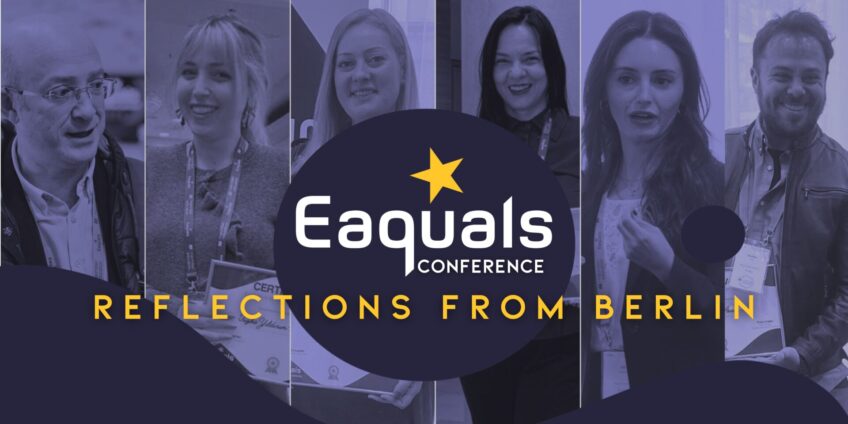
What stayed with us after Berlin
You know that slightly frustrating feeling when colleagues come back from a conference and say, “It’s hard to sum up, but it was really worthwhile”?
That’s more or less where many of this year’s Eaquals scholarship recipients and award winners landed. Not because they couldn’t explain it, but because what they took away wasn’t just a list of sessions or notes. It was a shift in perspective, conversations that stuck, and some ideas that are already finding their way into practice.
Here’s what stayed with them.
Seeing your own work differently
For Teacher Award recipient Işıl Özdemir, one of the most valuable parts of the conference was the chance to step outside her own context for a moment.
Presenting her work and hearing feedback from peers offered something quite simple, but often rare: the opportunity to see familiar practices through other people’s eyes. Not in a formal evaluation sense, but through open, thoughtful discussion.
It’s the kind of reflection that’s hard to build into everyday routines, and yet, when it happens, it tends to stay with you.
She also pointed to something many participants echoed: the sense that language classrooms are increasingly being seen as spaces for more than language itself. Places where critical thinking, global awareness, and personal development are part of the picture.
Taking ideas back that actually fit your context
A common thread across the scholarship recipients was practicality and ideas that felt adaptable.
Zeynep Sacan described returning to her institution with a clearer sense of direction, particularly around plurilingualism and the role of AI in both teaching and assessment. What mattered wasn’t just the content, but how it connected to her day-to-day responsibilities in both teaching and management.
Mehmet Abi had a similar experience, especially in sessions focused on AI policy and institutional strategy. For him, the value lay in how directly these discussions linked to decisions he’s currently facing in his role.
It’s one thing to hear about trends. It’s another to recognise where they fit (or don’t) in your own setting.
A reminder of the bigger picture
For Mirjana Grandov Lacic, the conference created space to reconnect with a bigger question: what exactly are we preparing learners for?
Her takeaway wasn’t tied to a single session, but to a broader idea that came up repeatedly, that is, language education plays a role in shaping how learners participate in the world, not just how they communicate within it.
Sessions on leadership and academic management added to this, offering ways to think about institutions over time: how they grow, where they plateau, and when change becomes necessary.
These aren’t questions most of us get to explore in depth very often, but they tend to linger once they’ve been raised.
Paying closer attention
Serhat Aşık experienced the conference slightly differently, stepping into the role of session moderator.
He noted that this changed how he listened. Being responsible for guiding sessions meant engaging more critically with the content, thinking not just about what was being said, but how it connected to wider developments in the field.
It’s a useful reminder that sometimes, the way we participate shapes what we take away.
Outside the sessions, he also highlighted the informal side of the conference, those in-between moments where conversations become less structured, but often more candid.
Conversations that continue beyond the session
That informal dimension came up again in Tuğba Yıldırım Kumbassar’s reflections.
Alongside presenting her own work, she spoke about the value of conversations that carried on after sessions ended, during breaks, over dinner, or simply while walking from one session to another.
These weren’t necessarily dramatic exchanges, but steady, thoughtful ones. The kind where ideas are tested, adapted, or sometimes quietly reconsidered.
She also pointed to the opening plenary on plurilingualism as a moment that set the tone, particularly the idea of seeing learners’ languages as connected resources rather than separate systems. It’s not a new concept, but hearing it explored through both theory and classroom practice made it feel more tangible.
What seems to be settling in
Looking across all the reflections, a few things seem to be settling into place, and many people are actively working through them:
- how to approach AI at an institutional level, not just in individual classrooms
- how to make plurilingual approaches workable in real teaching contexts
- how to balance immediate classroom needs with longer-term organisational thinking
None of these are quick fixes, but having the space to explore them, alongside others facing similar questions, seems to have made a difference.
Was it worth it?
In short, yes.
Not because everything was new, or because every session was groundbreaking, but because it created the kind of space that’s hard to come by otherwise.
Time to think.
Time to talk things through properly with other like-minded professionals
Time to look at your own context from a bit of a distance.
And judging by what people brought back with them, that time didn’t stay in Berlin.